Problem
Streaming anomaly detection drifts when thresholds, feedback, and operator judgment are disconnected from the model loop.
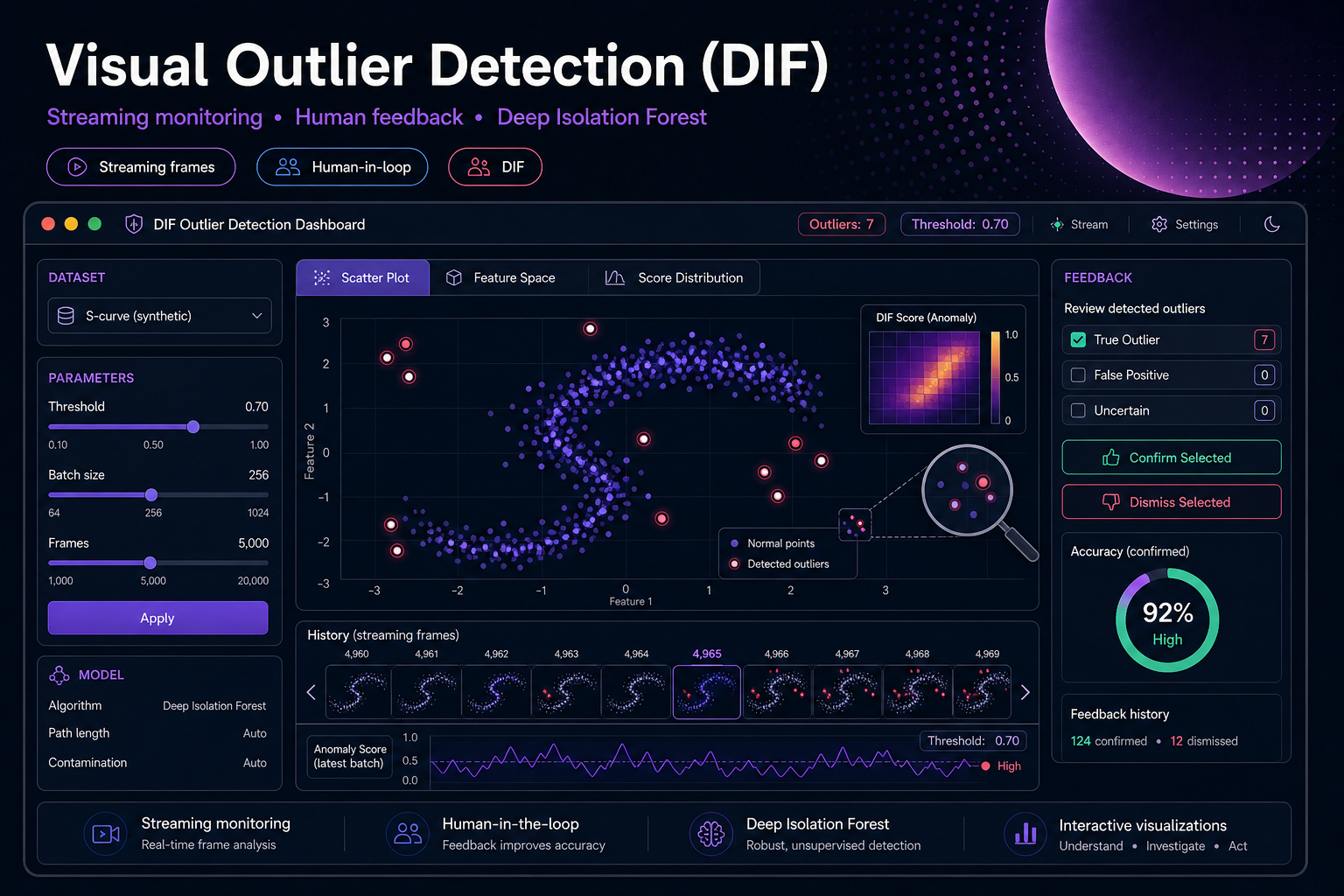
Master Project: interactive, web-based monitoring of outliers in streaming data with Deep Isolation Forest (DIF) and human-in-the-loop refinement.
This Master Project implements an interactive, web-based system to detect and monitor outliers in streaming data using Deep Isolation Forest (DIF), and to improve the quality of outlier decisions over time via human-in-the-loop feedback (a semi-supervised DIF workflow).
The core idea is to run DIF continuously on a stream represented as moving windows (“frames”), visualize inliers/outliers in the UI, and allow analysts to adjust parameters and correct labels (add/delete/relabel points). Those edits are fed back into subsequent runs, so the system becomes progressively better aligned with the user’s definition of “outlier”.
The frontend is an interactive dashboard built with React + D3 designed specifically for streaming workflows and iterative inspection. It supports:
Streaming anomaly detection drifts when thresholds, feedback, and operator judgment are disconnected from the model loop.
Deep Isolation Forest scoring runs over moving windows, while the UI supports parameter tuning and human feedback.
Monitoring gets stronger when human corrections are part of the operating workflow, not a separate annotation chore.
Demonstrates operator-loop design for model monitoring, which maps cleanly to agent trace review and drift workflows.
Use this as technical proof while reviewing reliability engagement options.
Send a problem briefThe system is implemented as a React client and a Flask backend centered around a backend API endpoint used to retrieve streaming results and submit user feedback. The backend maintains a rolling notion of stream state (batch size, number of batches/frames, and a last-index pointer), trains DIF on a recent window, scores a subsequent window, and returns predictions and labels for visualization.
max(score) - score < 0.06) derived from the current score distribution.Outlier detection in real environments is rarely a one-shot batch job: thresholds drift, definitions vary by operator, and feedback matters. This project demonstrates a practical approach to operational outlier monitoring—combining a strong detector (DIF), streaming-oriented UX, and feedback loops to continuously align the system with human judgment.