Problem
Teams often cannot explain agent runs, drift, or token spend after an incident or surprising output.
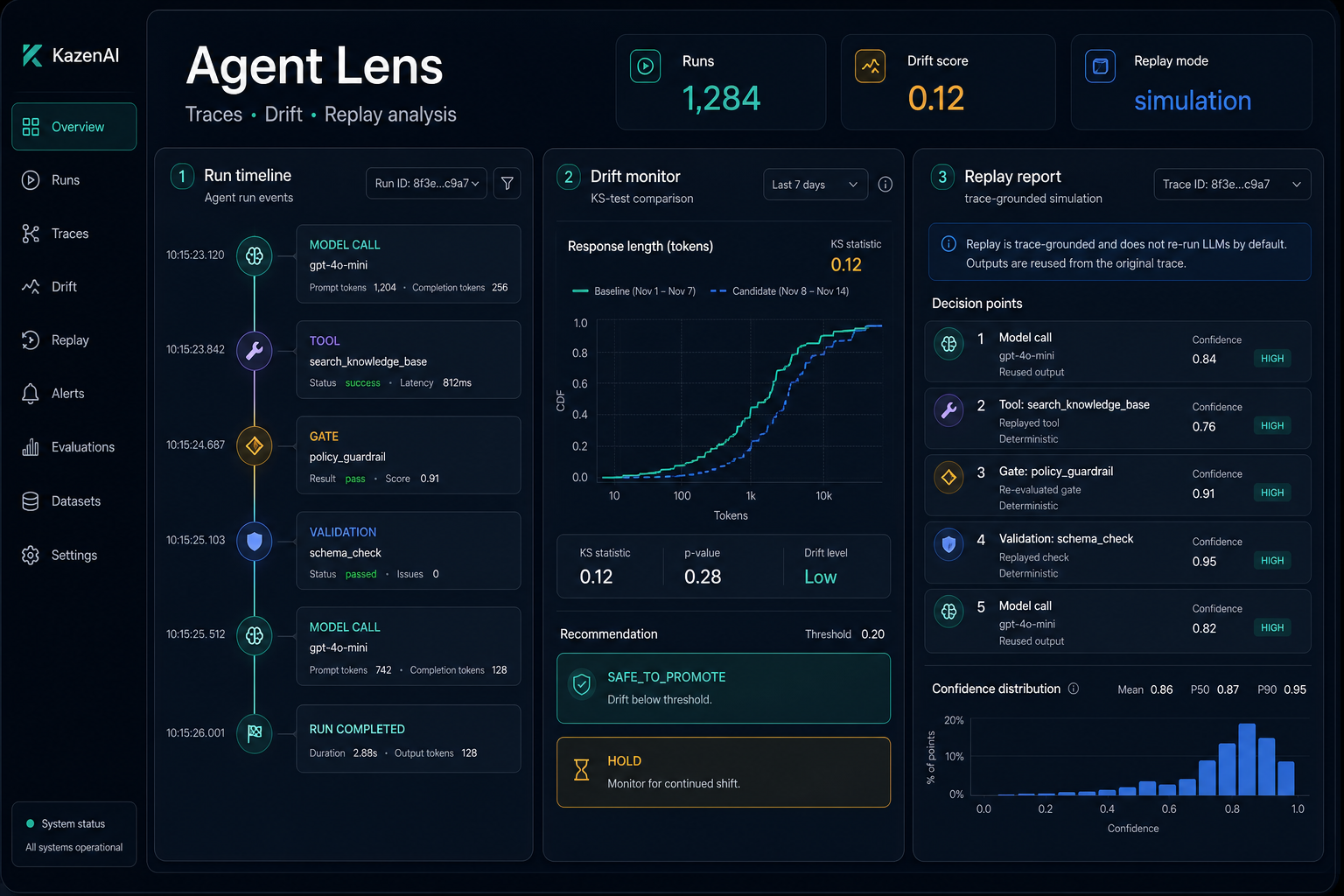
After the run: timelines you can read, drift you can act on, and replay that does not oversell determinism.
When an agent fails in production, teams need a record they can trust. Not a black box. Not marketing that pretends every “replay” re-runs the world identically.
Agent Lens gives operators readable run history, drift signals before the next promote, and analysis grounded in what was observed.
Work with me:
Teams often cannot explain agent runs, drift, or token spend after an incident or surprising output.
Trace timelines, drift checks, and replay analysis work from recorded evidence instead of silently re-running models.
Post-run review can diagnose behavior and cost without creating a second hidden model run.
Useful for audits and retainers where operators need stable evidence for failure review and monitoring decisions.
Use this pattern to inspect whether current traces are enough to trust production agents.
Send a problem briefFrozen run trace and trace-grounded replay report (reference system example).
model_call   planner   Fix the auth token expiry bug in src/auth.py
tool_call    read_file src/auth.py
tool_call    read_file tests/test_auth.py
model_call   coder     Fix the expiry comparison to use UTC timestamps
tool_call    write_file src/auth.py

replay_mode:    trace_grounded_report
trace_digest:   sha256:8f3a…c21e
Known limitation: Default replay analyzes recorded evidence; bit-identical live LLM re-execution is a separate, gated mode and is not the default production story.
Make agent behavior inspectable after the fact and cautious before the next release. Timelines operators can read. Drift awareness. Honest labeling of what replay means.
Default replay is framed as analysis of what already happened. That keeps buyers and operators from being misled about determinism.
I built Agent Lens as an evidence product: visibility, drift caution, and honest replay framing. Observability that supports trust, not another opaque dashboard.
Agent systems become operable when post-run evidence and release caution get the same seriousness as the agent itself. That is what audits surface and pilots install.