Problem
Agents can loop or call expensive models after budget authority is gone; the invoice arrives after the damage.
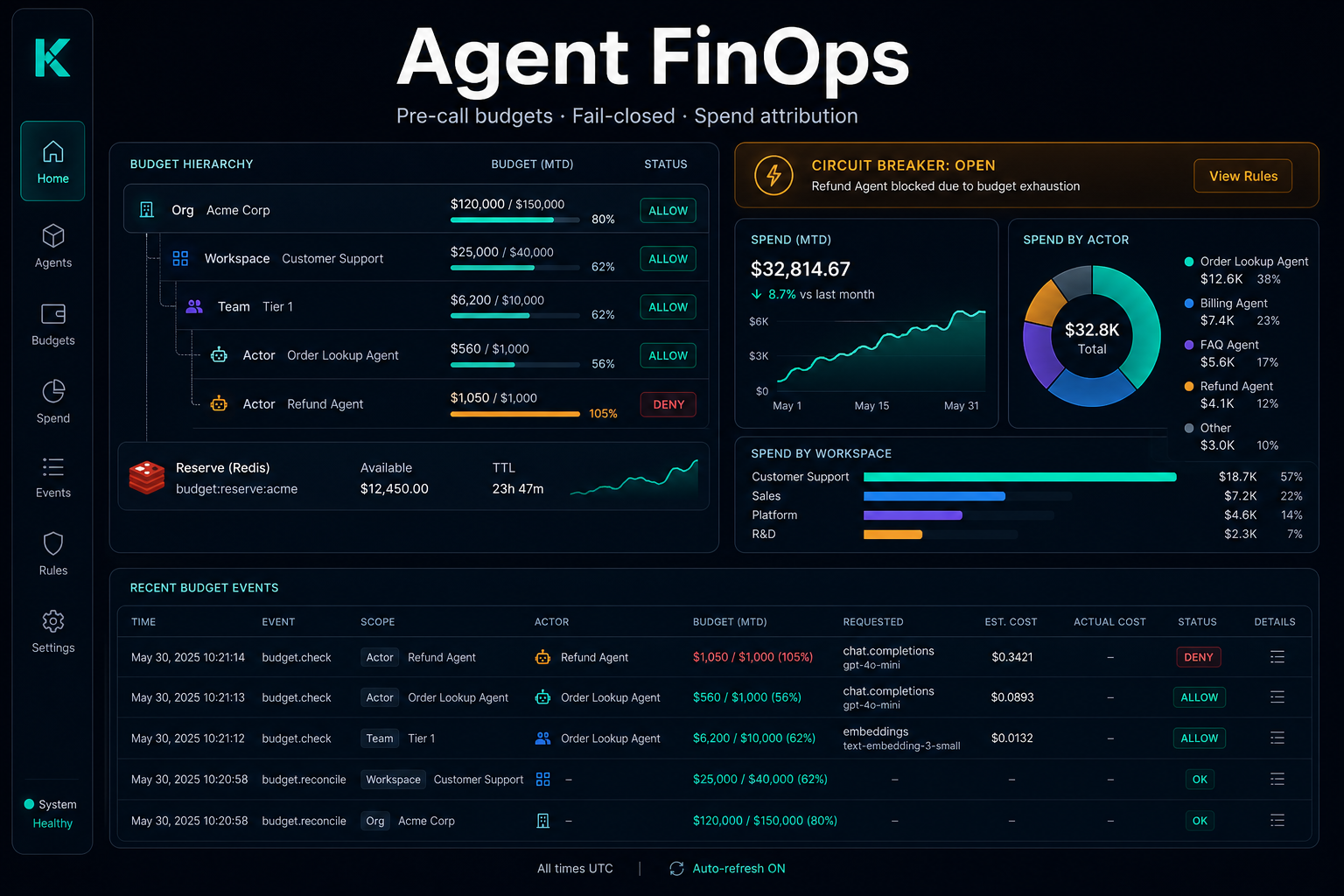
Most cost tools show the invoice. This one can refuse the call when the budget is gone.
Dashboards explain spend after the damage. Agent FinOps answers a harder question: can the system refuse an expensive call when the budget is already gone?
The outcome teams care about is simple. Hierarchical limits. Clear allow or deny. Attribution you can act on during the run, not only at month-end.
Work with me:
Agents can loop or call expensive models after budget authority is gone; the invoice arrives after the damage.
Policy checks budget, actor, workflow, and model request before spend happens, then fails closed when enforcement is unavailable.
Cost control can be active runtime enforcement, not a passive dashboard after the bill is generated.
Useful for diagnostics and sprints where agent workflows need explicit spend authority and operator-visible limits.
Use this pattern to scope a diagnostic or one fail-closed systems sprint.
Send a problem briefBudget reservation denied before the provider call (reference system example).
HTTP 402 Payment Required

available_budget_usd:  0.20
projected_spend_usd:   0.50
allowed:               false
avoided_cost_usd:      0.50
provider_call:         not executed
event:                 budget_reservation_denied
Known limitation: Redis-backed enforcement is required for production fail-closed behavior; in-memory mode is for local development only.
Make agent spend controllable before it hurts. Hard stops. Readable attribution. An operator view that treats cost as a reliability concern, not a finance afterthought.
Built for teams that already feel loop risk, fan-out, or surprise invoices. Cost decisions stay visible while the agent works, not buried in a monthly report.
I built Agent FinOps as cost control on the execution path: enforcement timing, operator clarity, and a clean link into the rest of a reliability practice. Not another reporting dashboard.
AI systems get safer when cost control sits in the execution path, not only in analytics after the bill arrives. That is the pattern audits and pilots install in your stack.