Problem
Company assistants hallucinate or leak context when retrieval, synthesis, and permissions are treated as one loose step.
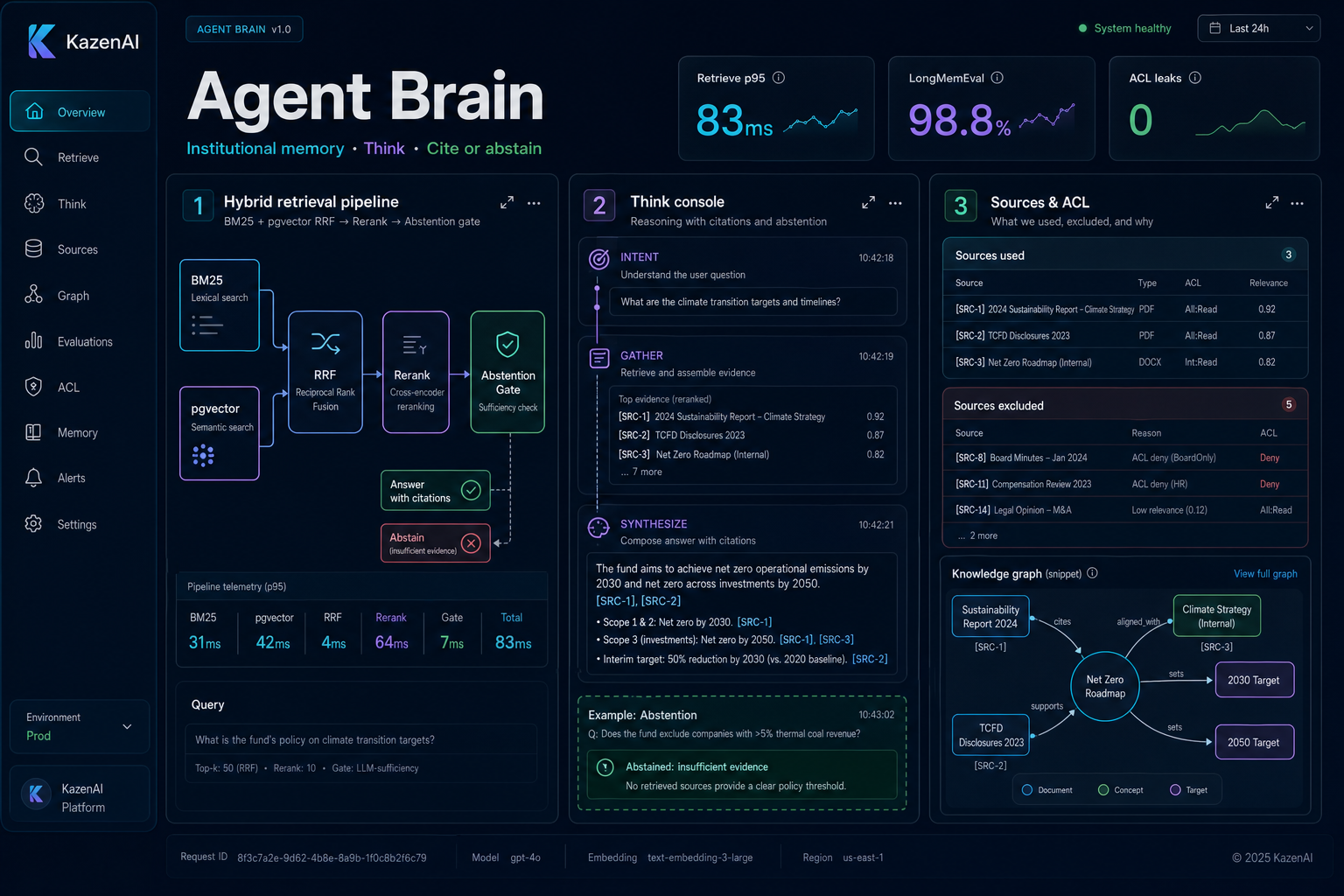
Company memory that cites its sources, or says there is not enough verified information.
Agents invent company facts when memory is weak. Agent Brain keeps answers tied to evidence, and can say “not enough verified information” instead of improvising.
The surface teams get is memory they can use for decisions, agent context, and operator Q&A, without treating every fluent answer as truth.
Work with me:
Company assistants hallucinate or leak context when retrieval, synthesis, and permissions are treated as one loose step.
Retrieval, reasoning, citation, abstention, and access-aware filtering are separated into visible control points.
Memory can stay useful under scrutiny when “not enough evidence” is a designed outcome, not a failure.
Useful when teams need grounded answers, operator confidence, and clear boundaries around what agents may know.
Use this pattern to assess or harden company-memory agent workflows.
Send a problem briefLongMemEval (latest full prod run): retrieval recall@5 on a memory corpus (k=5).
recall_at_k:                      0.988  (98.8%)
recall_at_k_ex_dataset_abstention: 0.9893 (98.93%)

hits / scored @k=5:
  hits:                     493 / 499
  hits_abstention_subset:  464 / 469
Known limitation: This is retrieval evidence (finding supporting material). Cite-or-abstain decisions still depend on downstream citation/governance gates and access-aware retrieval.
Institutional memory that is useful and accountable. Grounded answers. Visible sources. Access-aware recall. Abstention when the corpus cannot support a claim.
Memory products earn trust by what they refuse to say, not only by retrieval quality on easy questions.
I built Agent Brain around a clear contract: cite, abstain, and respect access. Not an unbounded chatbot over a document dump.
Institutional knowledge stays useful under scrutiny when the system stays honest when evidence is incomplete. That contract is what pilots and retainers put in place.