Problem
Kaggle-style work can devolve into unreproducible notebooks, scattered artifacts, and lost experiment context.
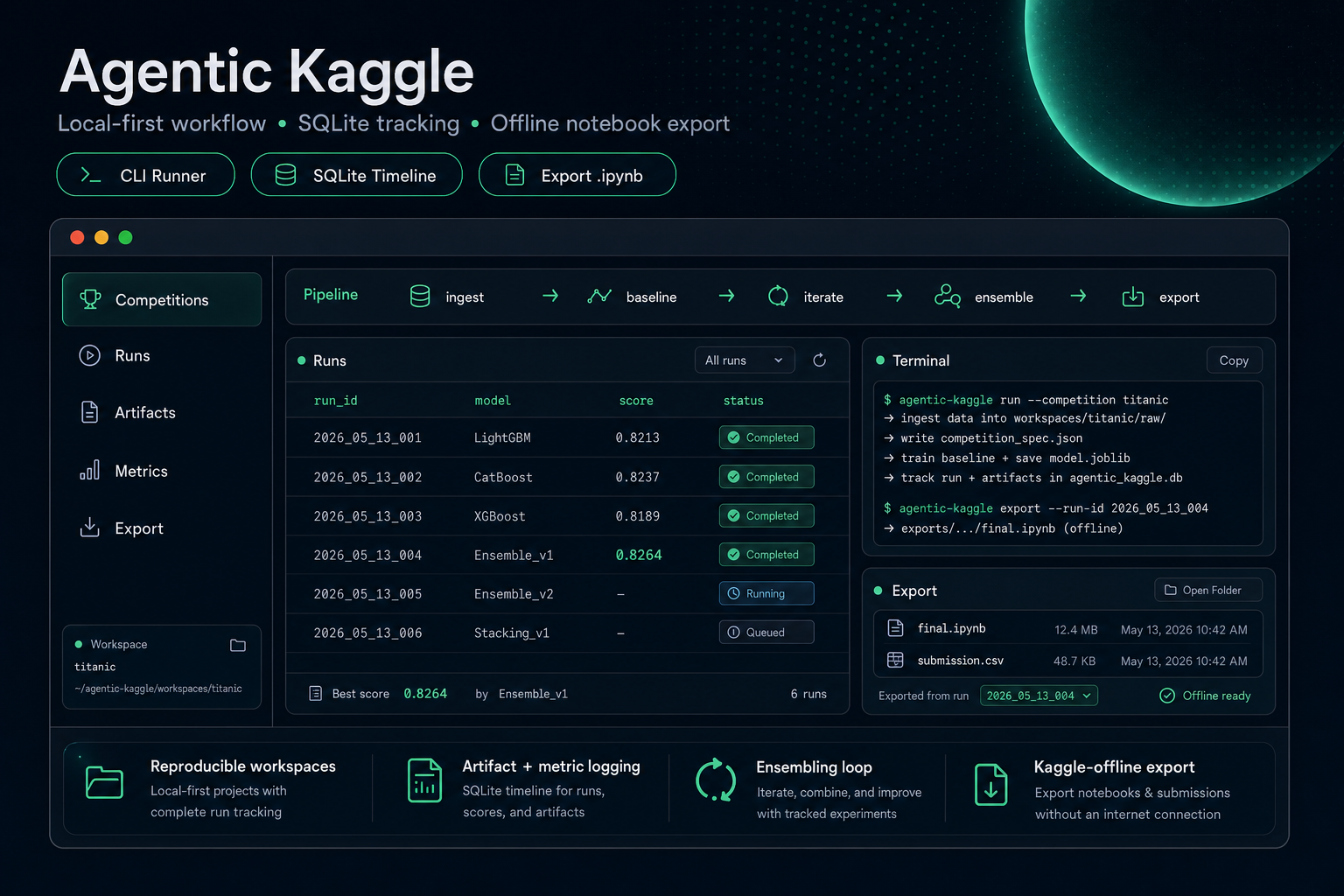
Local-first Kaggle framework with structured workspaces, SQLite experiment tracking, safe notebook mining, and offline export.
run, ingest-notebook, ensemble, export, and multi-phase helpersworkspaces/<slug>/raw|derived|runs|exportsAgentic Kaggle is a reproducible, local-first framework for running Kaggle competition workflows with clear artifact history. The focus is on the systems layer around experimentation: workspace structure, run tracking, safe data acquisition, ensemble management, and exportability.
Rather than hiding work inside ad hoc notebooks, the project makes each competition run explicit and recoverable, from downloaded inputs to generated metrics, submissions, and export notebooks.
Source code: private / available on request.
Kaggle-style work can devolve into unreproducible notebooks, scattered artifacts, and lost experiment context.
Structured workspaces, SQLite tracking, safe notebook analysis, ensemble helpers, and offline exports make runs recoverable.
Evaluation pressure improves when artifacts, metrics, and decisions are inspectable after the run.
Shows the same systems discipline used in agent reliability: repeatable workflows, audit trails, and safe automation.
Use this as technical proof while reviewing reliability engagement options.
Send a problem briefBuild a workflow for Kaggle-style experimentation that is repeatable, inspectable, and export-friendly. The project is meant to reduce the usual notebook chaos by giving each competition a consistent filesystem layout, a run ledger, and a clean path from baseline training to final notebook export.
A typical baseline run follows this sequence:
workspaces/<slug>/raw/.derived/competition_spec.json from the local files.oof.parquet, model.joblib, metrics.json, and submission.csv.agentic_kaggle.db.workspaces/<slug>/exports/<run_id>/final.ipynb.The framework enforces a predictable per-competition workspace:
raw/: downloaded competition inputsderived/: inferred specs, ideas, mined notebook metadata, and generated helper outputsruns/: per-run models, OOF predictions, submissions, metrics, and reportsexports/: final notebook packages for Kaggle submission workflowsMLFLOW_TRACKING_URI is configured, parameters, metrics, and artifacts can also be mirrored to MLflow.run: baseline workflow for a competition.ingest-notebook: analyze a local notebook file and store structured hints in SQLite.ensemble: build a blended run from prior OOF predictions and submission files.export: create an offline Kaggle notebook plus copied submission artifacts.sop, search, ideate, report, autoresearch: multi-phase helpers for planning, search, writeups, and iteration.watch, worker, scheduler: queue and process notebook/dataset mining jobs across competitions.The project is intentionally conservative about Kaggle content handling.
compliance.kaggle_mode=api_only avoids HTML scraping paths..ipynb files can be analyzed, but automated kernel scraping is not the default behavior.derived/notebooks/.This is a strong ML systems project because it treats Kaggle work as an engineering workflow, not just a notebook. It combines experiment tracking, artifact discipline, safe data handling, reproducible exports, and room for future agentic automation.